Imagine waking up to see your website traffic charting a steady, upward climb day after day. No massive ad spend draining your bank account. No chasing fleeting social media trends. Just a reliable stream of qualified visitors finding your business exactly when they need your solutions.
That is the power of organic traffic.
For small businesses, startups, eCommerce stores, and bloggers worldwide, relying purely on paid ads is a fast track to burning through cash. Once you stop paying for ads, your traffic drops to zero. Organic search engine optimization (SEO), on the other hand, acts as an appreciating asset. It builds compounding value over time.
Unfortunately, many website owners approach SEO using outdated tactics. They stuff keywords into thin content, buy cheap, spammy backlinks, or ignore the technical health of their sites. Then, they wonder why their Google rankings stall or disappear entirely after a core algorithm update.
Today’s search ecosystem is smarter than ever. With Google’s emphasis on Experience, Expertise, Authoritativeness, and Trustworthiness (E-E-A-T), alongside the rise of AI Overviews, ChatGPT, Gemini, and Perplexity, your content must satisfy both human intent and sophisticated search algorithms.
This comprehensive guide breaks down exactly how to increase organic traffic using sustainable, white-hat SEO strategies. No fluff, no AI clichés—just an actionable, step-by-step roadmap to scale your online visibility.
What Is Organic Traffic?
Organic traffic refers to the visitors who arrive at your website as a result of unpaid search results. When a user enters a query into a search engine like Google, Bing, or Yahoo, they are presented with a Search Engine Results Page (SERP). This page displays sponsored advertisements at the top and bottom, with the organic listings situated in between.
+------------------------------------------+
| [ Search Query: Best CRM Software ]      |
+------------------------------------------+
| [Ad] Sponsored Link - Paid Traffic       |
| [Ad] Sponsored Link - Paid Traffic       |
+------------------------------------------+
|  AI Overview / Featured Snippet          |
+------------------------------------------+
| #1 Organic Result - Free, Earned Traffic |
| #2 Organic Result - Free, Earned Traffic |
| #3 Organic Result - Free, Earned Traffic |
+------------------------------------------+
Unlike paid traffic, which stops the moment your campaign budget runs dry, organic website traffic is earned. It is driven by your site’s relevance, structural health, and authority regarding specific search queries.
Why Organic Traffic Is Important for Business Growth
For any growing digital footprint, organic search is the ultimate growth lever. Here is why prioritizing organic traffic over short-term paid channels is essential for long-term commercial success:
- High Cost-Efficiency: While building high-quality content and optimizing your site requires an upfront investment of time or capital, you do not pay for individual clicks. The cost per acquisition drops dramatically over time.
- Compounding Long-Term Value: A well-optimized blog post published today can attract thousands of targeted visitors every month for years with minor updates.
- Enhanced Credibility and Trust: Modern web users are highly sophisticated. Many consciously skip past paid ads because they inherently trust organic results more. Ranking at the top of Google signals to prospects that your business is a credible industry leader.
- Targeted Intent: People typing specific phrases into search engines are actively looking for answers, products, or services. This means organic visitors are often highly qualified leads who are much closer to making a purchasing decision than passive social media scrollers.
How Search Engines Rank Websites
To shift your organic visibility into high gear, you must understand how search engines function. Google uses automated software programs known as “crawlers” or “spiders” to scan the internet. The process unfolds in three primary phases:
[ Crawling ] ---------> [ Indexing ] ---------> [ Ranking ]
(Discovering Pages)     (Analyzing & Storing)    (Evaluating 200+ Signals)
- Crawling: Search engines deploy bots to discover new and updated content across the web. They find your pages by following links from existing pages or by reading your XML sitemap.
- Indexing: Once a page is crawled, the search engine parses its content, layout, and structural elements to understand what the page is about. This information is stored in a massive database called the search index.
- Ranking: When a user types a query, Google evaluates thousands of data points across its index within milliseconds. It uses more than 200 ranking signals—including relevance, content depth, site speed, mobile usability, and backlink authority—to present the most helpful results.
In recent years, search engines have moved beyond simple keyword matching. Algorithms now evaluate how well a page satisfies a user’s underlying intent and whether the site demonstrates real-world experience and trustworthiness.
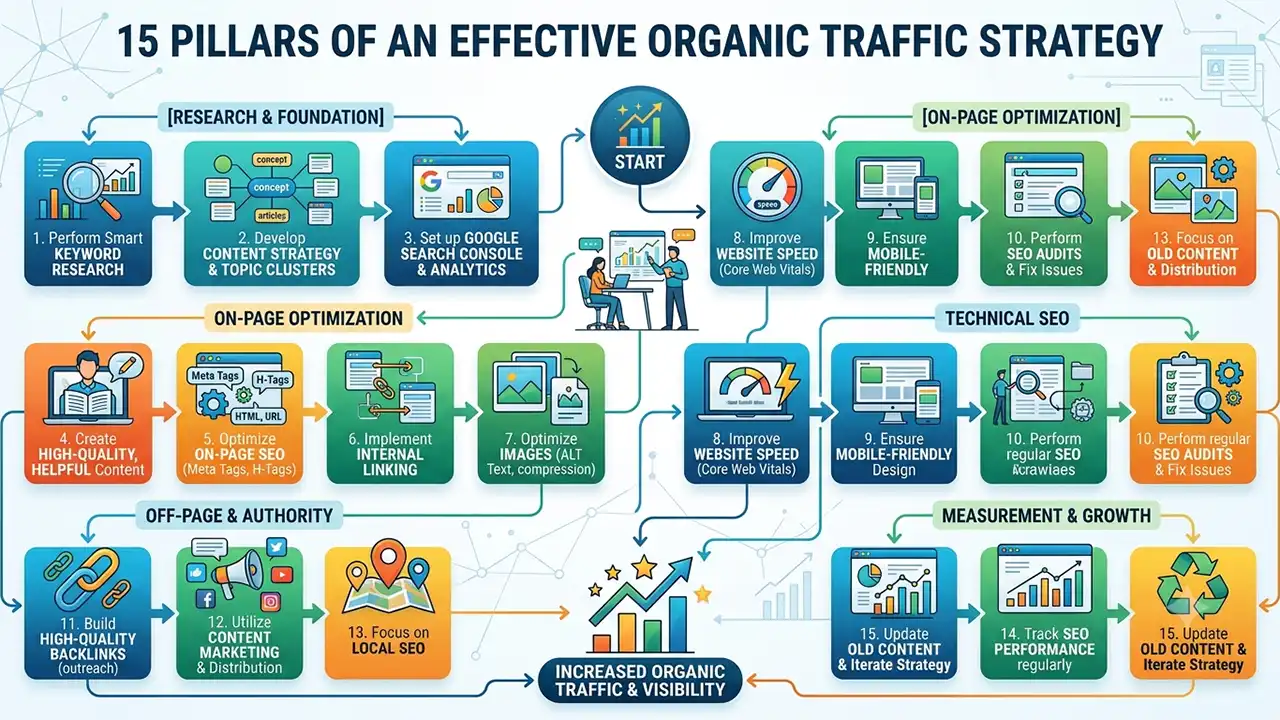
15 Proven Ways to Increase Organic Traffic
1. Perform Smart Keyword Research
Successful search engine optimization starts with comprehensive keyword research. If you do not know what your target audience is typing into search bars, you are writing in the dark.
Move away from highly competitive, single-word terms. Instead, focus on long-tail keywords—longer, more specific phrases that display clear transactional or informational intent. For example, instead of targeting “SEO,” target “SEO strategies for local eCommerce stores.”
- Actionable Tip: Use tools like Google Keyword Planner or SEMrush to find high-volume, low-competition keywords. Map these target terms to specific pages on your site to prevent keyword cannibalization (where multiple pages compete against each other for the same term).
2. Create High-Quality Content
In the realm of content marketing, quality is your strongest competitive advantage. Search engines prioritize depth, originality, and user value over raw output volume.
High-quality content provides comprehensive answers to user queries, addresses pain points directly, and introduces fresh data or unique perspectives. Google’s Helpful Content system is specifically designed to reward content that leaves visitors feeling satisfied and informed.
- Actionable Tip: Write for humans first, not search bots. Avoid generic summaries. Conduct original research, interview internal experts, include case studies, and format your text with clear headings so it is highly scannable.
3. Optimize On-Page SEO
On-page SEO involves optimizing the individual elements on your web pages so search engines can easily understand their context and relevance.
Key on-page optimization factors include:
- Title Tags: Place your primary keyword near the beginning of your title, keeping the total length under 60 characters.
- H2 & H3 Headings: Organize your content structurally, weaving in secondary and LSI (Latent Semantic Indexing) keywords naturally.
- Meta Descriptions: Write compelling, click-worthy summaries under 155 characters that include a clear call-to-action (CTA).
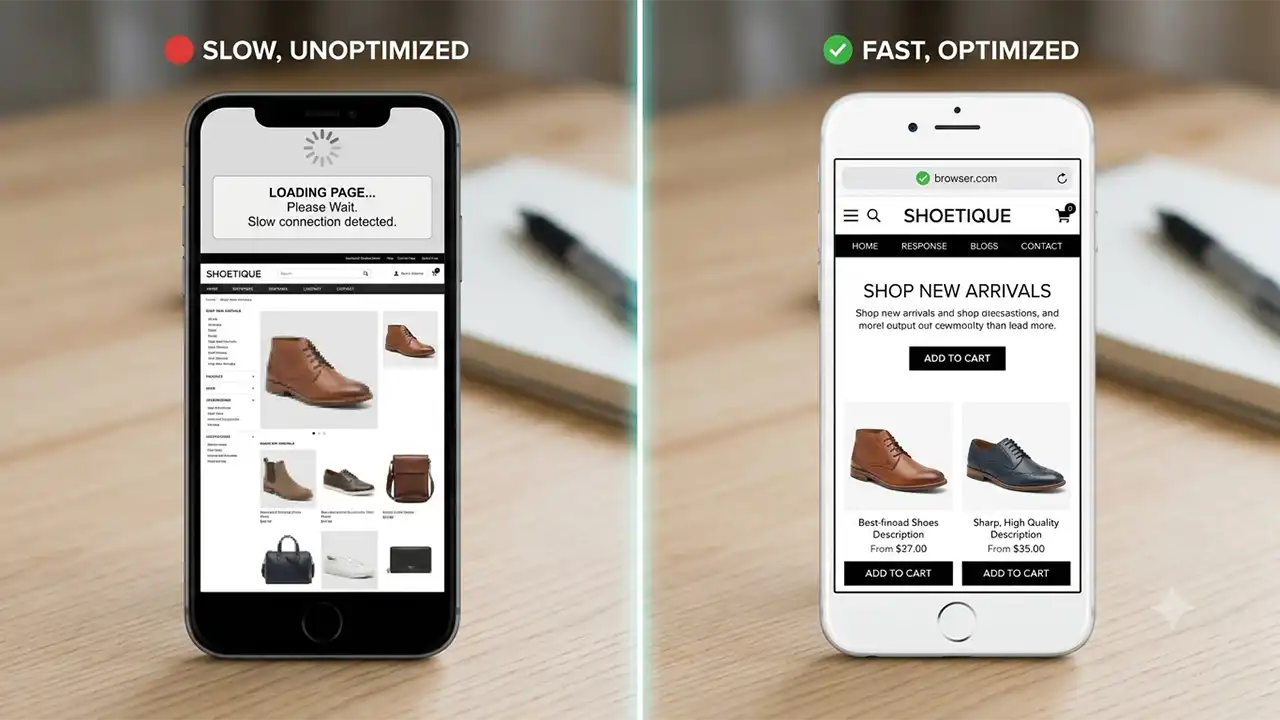
4. Improve Website Speed
User experience and site performance are directly tied to your search visibility. If your pages take longer than three seconds to load, a significant percentage of visitors will bounce back to the SERPs, signaling to Google that your site offers a poor experience.
Google quantifies user experience through a set of real-world performance metrics called Core Web Vitals. These measure visual stability, interactivity, and loading speeds.
- Actionable Tip: Compress heavy images, leverage browser caching, minimize CSS and JavaScript files, and choose a high-quality, managed hosting provider to keep your site fast and nimble.
5. Make Your Website Mobile Friendly
More than half of global web traffic originates from mobile devices. Google uses mobile-first indexing, meaning the search engine evaluates and ranks your website based primarily on how it looks and performs on a smartphone screen.
- Actionable Tip: Test your pages using responsive design tools. Ensure your text sizes are legible without zooming, buttons are easy to tap, and pop-ups do not obstruct the main content on smaller viewports.
6. Fix Technical SEO Issues
A beautiful website is useless if search crawlers cannot access its content. Regular technical health checks ensure that search engines can crawl, index, and render your pages without friction.
- Actionable Tip: Conduct a monthly SEO audit to identify and resolve broken links (404 errors), redirect loops, duplicate content, and unindexed pages. Ensure your XML sitemap is properly configured and submitted via Google Search Console so search bots always have a clear map of your site’s structure. If this feels overwhelming, partnering with professional Technical SEO Services ensures your site’s infrastructure remains flawless.
7. Build High-Quality Backlinks
Link building remains a fundamental pillar of organic search algorithms. Think of a backlink—a link from an external website to yours—as a digital vote of confidence.
However, not all links are created equal. One link from an authoritative, trusted industry publication is worth more than hundreds of low-quality links from spammy directories. Focus on earning high-quality backlinks through editorial outreach, guest blogging on reputable sites, and creating highly linkable assets like original research or interactive tools.
8. Optimize Internal Linking
While external links build your site’s authority, internal linking distributes that authority across your individual pages. It also helps search engines discover new content and map out your site’s hierarchy.
- Actionable Tip: When publishing a new post, link back to your core service pages or relevant older articles using descriptive, keyword-rich anchor text. Avoid generic phrases like “click here” or “read more.” For instance, linking to our specialized SEO Services page with descriptive anchor text tells search engines exactly what that target page offers.
9. Update Old Blog Posts
You do not always need to write from scratch to boost your organic search numbers. Over time, high-ranking content can decay as facts change, statistics age, and competitors publish newer pieces.
Review your historical content asset library annually. Refresh outdated statistics, add new insights, fix broken links, and optimize the copy for newer target search queries to quickly recover lost rankings.
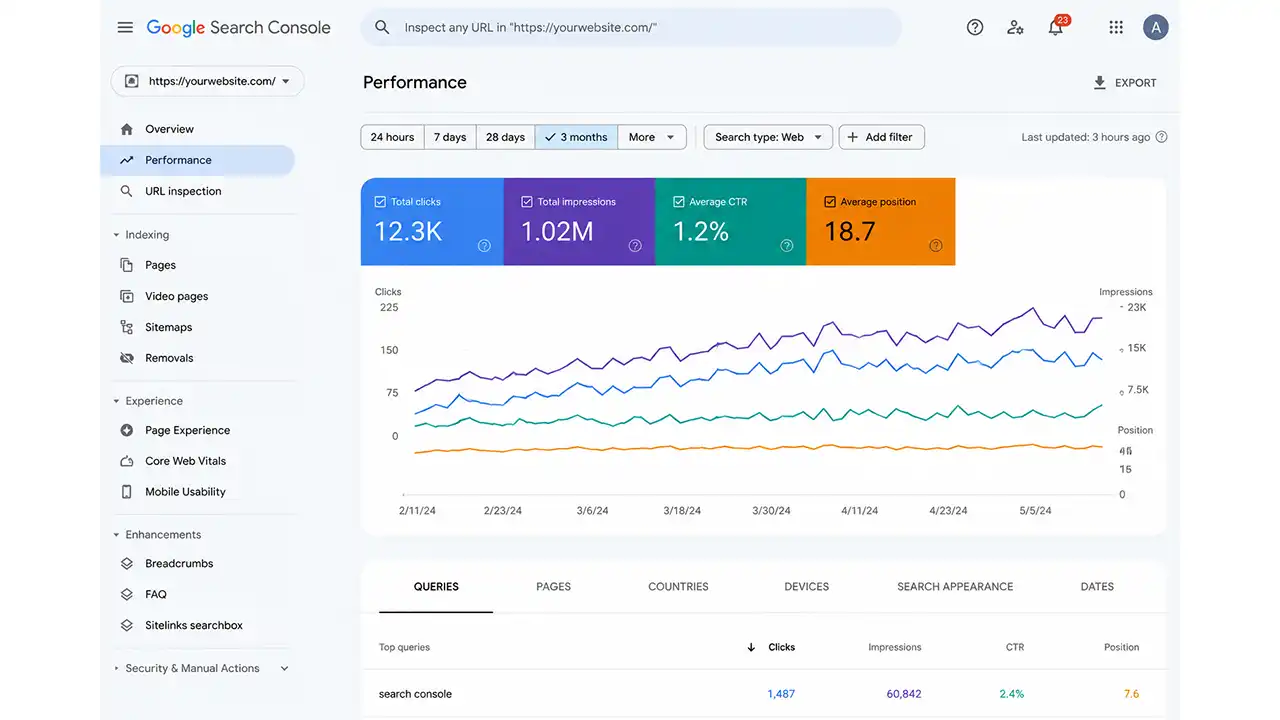
10. Use Google Search Console
Google Search Console is a powerful, free tool provided directly by Google to help you monitor and maintain your site’s search footprint.
It provides transparent data regarding the exact search queries driving traffic to your pages, your average ranking positions, impressions, and click-through rates (CTR). It also alerts you to indexing issues, security flaws, or manual penalties that require immediate attention.
11. Improve User Experience
Search algorithms look at dwell time, scroll depth, and interaction patterns to determine if your site provides value. A messy layout, poor readability, or overly intrusive pop-up ads frustrate users, driving them to leave your site almost immediately.
- Actionable Tip: Break up walls of text by keeping your paragraphs under three sentences. Use bullet points, bold key phrases, and embed relevant videos or charts to make your content easy to read and highly engaging.
12. Optimize Images
Images make your content visually engaging, but they can slow down your site if they are not handled correctly. They also represent an often-overlooked traffic source: Google Images.
- Actionable Tip: Always compress your images before uploading them. Use descriptive file names (e.g.,
how-to-increase-organic-traffic.jpginstead ofIMG_4829.jpg) and write detailed, descriptive ALT text for every image to ensure web accessibility and search engine clarity.
13. Publish Topic Clusters
Instead of targeting isolated keywords with disconnected blog posts, build organized topic clusters. A topic cluster consists of a single, comprehensive “pillar” page (like this guide) that links to multiple, highly focused “sub-topic” articles, and vice versa.
                  +-----------------------+
                  |  Core Pillar Page     |
                  |  (Broad Target Term)  |
                  +-----------+-----------+
                              |
         +--------------------+--------------------+
         |                    |                    |
+--------v-------+   +--------v-------+   +--------v-------+
| Cluster Post A |   | Cluster Post B |   | Cluster Post C |
| (Specific Sub) |   | (Specific Sub) |   | (Specific Sub) |
+----------------+   +----------------+   +----------------+
This structural approach shows search engines that your website possesses deep, systemic topical authority on a given subject, raising the search visibility of all pages within the cluster.
14. Optimize for Featured Snippets & AI Search
Modern search landscapes rely heavily on direct answers. Google often displays “Featured Snippets” at the very top of search results, and AI platforms pull information directly from trusted sites to populate their summaries.
To optimize for these formats, structure your content cleanly. Provide clear, direct, dictionary-style answers (40–60 words) immediately below your H2 or H3 subheadings to make it easy for conversational AI models to extract your insights.
15. Track SEO Performance Regularly
You cannot manage what you do not measure. Use analytics platforms to track key performance indicators (KPIs) like organic sessions, bounce rates, conversion rates, and keyword rankings over time.
Regular monitoring allows you to quickly identify what is working, pivot away from strategies that aren’t yielding results, and find hidden optimization opportunities before your competitors do.
Common SEO Mistakes That Reduce Organic Traffic
Even seasoned web professionals can fall into structural traps that quietly sabotage their search growth. When diagnosing a sudden drop in visibility, look out for these common errors:
| SEO Mistake | Why It Harms Your Rankings | How to Fix It |
| Keyword Stuffing | Repeating target terms excessively looks unnatural and triggers search quality spam filters. | Write naturally; use natural synonyms and LSI keywords instead. |
| Neglecting Search Intent | Creating transactional sales pages when users are looking for informational guides leads to poor engagement. | Analyze current top-ranking pages to see what content format users prefer. |
| Ignoring Local SEO | Missing local optimization opportunities causes brick-and-mortar brands to lose nearby customers. | Claim and optimize your Google Business Profile; add local schema markup. |
| Thin Content | Publishing brief, shallow pages that offer zero unique value fails to meet quality standards. | Consolidate short posts or expand them with real-world examples and deep analysis. |
| Broken Redirects | Leaving broken links unchecked ruins your site’s navigation and misleads search crawlers. | Implement 301 redirects to steer users toward relevant active URLs. |
How Long Does It Take to Increase Organic Traffic?
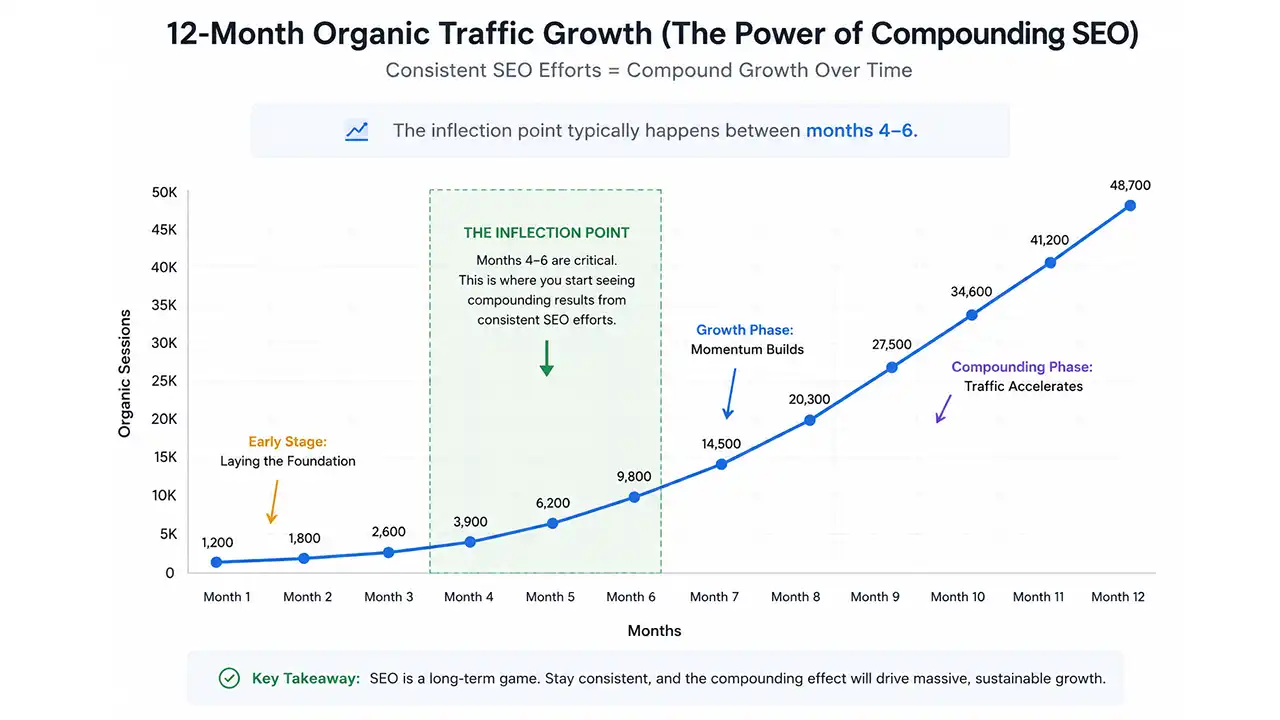
SEO is a long-term strategy, not an overnight fix. Unlike paid ads that deliver immediate traffic, organic search growth takes time because search engines must crawl your modifications, assess your data quality, and adjust their global index accordingly.
For most new websites, noticeable growth typically requires 4 to 6 months of consistent optimization.
Month 1-2: Technical fixes, site speed optimization, and initial keyword research.
Month 3-4: Publishing cluster content and early backlink acquisition.
Month 5-6: Initial keyword indexation and gradual ranking improvements.
Month 6+: Compounding traffic growth and stable authority.
The exact timeline depends on several clear variables:
- The age and current authority of your domain.
- The keyword competition levels within your specific industry.
- The quality, depth, and publishing frequency of your new content assets.
- The responsiveness and technical health of your website infrastructure.
While it requires patience, the wait is worth it. The organic traffic you establish today creates a stable foundation for years of sustainable online growth.
Tools You Need
To scale your organic visibility efficiently, you need access to reliable data insights. Here is a baseline toolkit recommended for managing your optimization workflows:
Google Search Console
An absolute necessity for any site owner. It allows you to submit XML sitemaps, track your exact organic indexation metrics, monitor indexing errors, and review the keyword terms driving real-world impressions and clicks.
Google Analytics
This platform helps you understand exactly what users do once they land on your site. Use it to track user demographic data, identify high-performing content assets, analyze bounce rates, and measure your actual business lead conversions.
Google Keyword Planner
A highly reliable, free tool built directly inside the Google Ads environment. It is exceptional for discovering new keyword variations, pulling search volume estimates, and mapping out structural content campaigns.
Ahrefs
A premium, industry-standard SEO platform. Ahrefs excels at deep backlink analysis, competitor research, keyword difficulty scoring, and tracking systemic keyword ranking movements day by day.
SEMrush
An all-in-one digital marketing intelligence software suite. It offers powerful toolsets for comprehensive website optimization, competitor tracking, on-page SEO audits, and uncovering hidden organic search opportunities.
Screaming Frog
A desktop-based website crawler built for deep technical auditing. It quickly scans your site to flag broken links, duplicate content issues, missing metadata, and unoptimized redirect paths.
Final Thoughts
Learning how to increase organic traffic is not about chasing loopholes or trying to outsmart search algorithms with shortcuts. It comes down to providing an exceptional user experience, maintaining a clean technical infrastructure, and consistently creating high-quality, trustworthy content that addresses your audience’s needs.
SEO is an ongoing process that requires time, data tracking, and strategic persistence. But when executed correctly, it transforms your website into a powerful lead-generation engine that works for your business around the clock.
If you are ready to stop guessing and start scaling your online presence, we can help. At XyronByte SEO, we specialize in designing customized, data-driven digital marketing roadmaps that drive real revenue growth. Discover more about our approach on our About Us page, or check out our complete suite of Digital Marketing Services to see how we can elevate your brand.
Ready to dominate search engine results? Contact XyronByte SEO today to schedule your free, custom website audit and SEO consultation with our engineering team!